
India has gained the least since Russia invaded Ukraine in February 2022 and was penalised the most, while the US, China and the European Union emerged as the biggest beneficiaries from the war.

The United States Central Command confirmed that the USS Rafael Peralta intercepted an Iranian-flagged ship, enforcing a maritime blockade against Iran. The US military is prepared to resume major combat operations if ordered by the President.

India should not stay on the margins of this initiative. There should be a serious debate about what would be in India's best interests asserts former foreign secretary Shyam Saran.
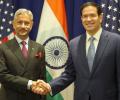
US Secretary of State Marco Rubio has said that the Trump administration hopes it can fix the "measures" it has taken with regard to India for its purchases of Russian oil.

Tensions escalate as Iranian forces attack a container ship in the Strait of Hormuz after Trump announced the ceasefire extension.
There are enough people at the top decision-making level in Tehran who are still willing to negotiate, provided Trump can create the right setting for the negotiation to acquire a dynamic of its own, points out Ambassador M K Bhadrakumar.

Iran has presented a multi-layered proposal to the US in an attempt to break the deadlock in peace talks, focusing on de-escalation and nuclear programme discussions.

According to a statement cited by TASS, the Russian foreign ministry said it is closely monitoring reports that the US military has boarded the tanker Mariner, originally Bella 1, on the high seas, noting that Russian citizens are among the crew.

Reliance Industries Ltd has consistently remained compliant with international sanctions and is expected to adhere to upcoming measures on Russian oil, analysts said, estimating that oil sourced from Russia contributes just 2.1 per cent to its consolidated EBITDA. Reliance operates the world's largest single location refining complex, with more than half of the capacity exclusively dedicated for exports.
The United States has imposed sanctions on at least half a dozen Indian companies accused of trading in Iranian petroleum and petrochemicals as part of broader action targeting 20 entities worldwide.

Russian Foreign Minister Sergei Lavrov will visit Beijing to discuss the West Asia conflict, the Strait of Hormuz blockade, and bilateral relations with Chinese leaders.

Where are the most oil reserves in the world? Who owns them? Find out!

Russian President Vladimir Putin is set to visit China for talks with Chinese leader Xi Jinping, shortly after US President Donald Trump's visit to Beijing. The visit underscores the close strategic ties between China and Russia amid global tensions.

Delhi must now purge the delusional hopes of being a 'counterweight' to China in the US calculus, argues Ambassador M K Bhadrakumar.

US President Donald Trump has indefinitely extended the ceasefire with Iran at the request of Pakistan, aiming to allow Tehran's leadership time to form a unified proposal to end the seven-week war.

Chinese President Xi Jinping warned US President Donald Trump that mishandling the Taiwan issue could trigger conflicts between the two countries during wide-ranging talks on trade, Iran, and energy security.

Shares of Reliance Industries Limited (RIL) tumbled on Tuesday, posting its biggest single-day decline in 19 months, amid controversy over its purchase of Russian oil and profit-booking after recent gains.

US President Donald Trump and Russian President Vladimir Putin discussed the Iran conflict and its impact on global energy supplies during a phone call.
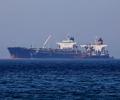
The US has sanctioned an Indian national based in the United Arab Emirates and two India-based entities for operating as part of Iran's shadow fleet and involved in shipping Iranian oil. The US Department of the Treasury said Jugwinder Singh Brar, who owns multiple shipping companies, operates as part of Iran's shadow fleet, which the US said is used to evade sanctions and transport Iranian oil. Brar also owns or controls India-based shipping company Global Tankers Private Limited and petrochemical sales company B and P Solutions Private Limited. The sanctions come as part of a US campaign of maximum pressure on Iran and target the country's petroleum and petrochemical sectors.

Iran was the chance to arrange a concert of nations, to actually be a Vishwaguru. Instead, we are watching from the sidelines as Pakistan, the same country that is apparently still at war with Afghanistan, hosts talks between US-Israel and Iran. The irony is hard to miss, points out Amberish K Diwanji.

For that to happen America does not have to lose. It only has to do the right thing, asserts Aakar Patel.
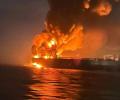
Ukraine claimed responsibility after explosions hit the vessels on Friday and Saturday.

China has criticised the US blockade of the Strait of Hormuz, calling it a dangerous and irresponsible move, and urged Washington and Tehran to honour the ceasefire. Beijing also denied aiding Iran militarily and threatened countermeasures if the US imposes tariffs.

Whatever be India's course of action, it will have an impact on India-Iran ties, notes Aveek Sen.
The logic of war plus the gathering storms in US politics as the midterms loom large leave him with no real alternative but to negotiate, points out Ambassador M K Bhadrakumar.
Russian shipments averaged 1.67 million barrels per day in January compared to 1.48 million bpd in December and 1.53 million bpd a year earlier.

In a post on Truth Social, Trump outlined key goals of the campaign, including degrading Iran's missile capabilities, dismantling its defence industrial base, eliminating naval and air power, preventing Tehran from acquiring nuclear capability, and protecting United States allies such as Israel, Saudi Arabia and the United Arab Emirates.
The Trump administration has sanctioned entities and individuals from India involved in sales of Iran's petroleum and petroleum products, saying the funds from this trade support Tehran's regional terrorist proxies and procure weapons systems that are a direct threat to the US.

The United States has clarified that its naval blockade in West Asia targets Iranian ports and coastline, not the Strait of Hormuz, applying to all ships regardless of nationality. US officials warned Iran against threatening commercial ships and hinted at ceasefire negotiations as an alternative.
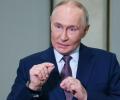
Russian President Vladimir Putin on Thursday described the latest United States sanctions as an 'unfriendly move' that would not help relations between Moscow and Washington, DC.

Reliance Industries Ltd on Thursday said it has halted the use of Russian crude at its export-only refinery in Jamnagar, Gujarat, as the company moves to comply with European Union sanctions. Reliance is India's largest buyer of Russian oil, which it processes and turns into fuel, such as petrol and diesel, at its giant oil refining complex at Jamnagar.

The embassy also said that the exit must be undertaken in coordination with the mission.

The meeting follows a ceasefire agreement that was announced and welcomed by Shehbaz Sharif, who also extended invitations to both delegations for further negotiations.

Donald Trump has issued a stern warning to Iran, stating that the US will take a tougher stance if a diplomatic resolution regarding its nuclear programme is not reached soon.

The clock on the ceasefire is running out. But everyone's already whispering about round two, possibly as soon as this weekend.

A US lawmaker has criticized President Donald Trump's tariff policy on India for purchasing Russian oil, urging him to reverse it immediately.

The cost of the war is being counted not in the corridors of power in Washington or Tehran, but in Firozabad's darkened furnace rooms, Howrah's idle casting sheds, and a barbershop in Kochi where the wait is suddenly, inexplicably, an hour long, notes Prem Panicker in his must read blog on the Iran War.

Iran is fighting a different war: Older, slower, and in some ways more dangerous. Iran doesn't need to shoot down an F/A-18. It only needs to make the Strait of Hormuz feel dangerous long enough for insurance markets, shipping companies, and oil futures traders to do the rest. Prem Panicker continues his must-read daily blog on the war in the Middle East.

By all available indications, the White House drafted a face-saving note and handed it, ready-made, to Islamabad. Pakistani Prime Minister Shehbaz Sharif was supposed to then post it in the guise of a plea urging Trump to extend the deadline by two weeks 'to allow diplomacy to run its course'. Trump would then graciously accept Pakistan's 'request' and declare a ceasefire. Sharif dutifully posted the message on X. Except that he, or whoever was handling the account, forgot to delete the tell-tale first line visible in the edit history: 'Draft - Pakistan's PM Message on X'. Prem Panicker's must read blog on the Iran War.

The core issues to be settled -- access to Hormuz, Israel's aggression in Lebanon, the question of Iran's nuclear programme, sanctions relief and compensation -- are thorny enough to require weeks of patient negotiation. The most likely outcome of the opening sessions is that both sides take the measure of each other, establish what is and is not negotiable, and return home without having broken anything. That would count as progress.
